NAICS 23
OSHA compliance for construction, from fall protection to silica.
OSHA compliance for construction is governed by 29 CFR 1926, and construction is the most-cited industry in the federal record, with standards that change faster than in any other sector. Cairn keeps your superintendents and foremen current on Subpart M fall protection, Subpart P trenching and excavation, the silica standard, and the directives that apply to the work.

Construction enforcement record
Search inspections, violations, accident narratives, and abatement disputes from the agency record.
Regulatory text by subpart
The applicable sections of 1926, kept current as revisions are published.
Multi-employer interpretations
Decades of interpretations on the responsibilities of general contractors and subcontractors, and on defending citations.
Benchmarking by trade
Compare TRIR, DART, and citation profile by trade and project type.
Interactive figures
See the rules at work
The standards your inspector opens first
The standards below are the most cited in Construction (NAICS 23), and every reference links to the standard on osha.gov.
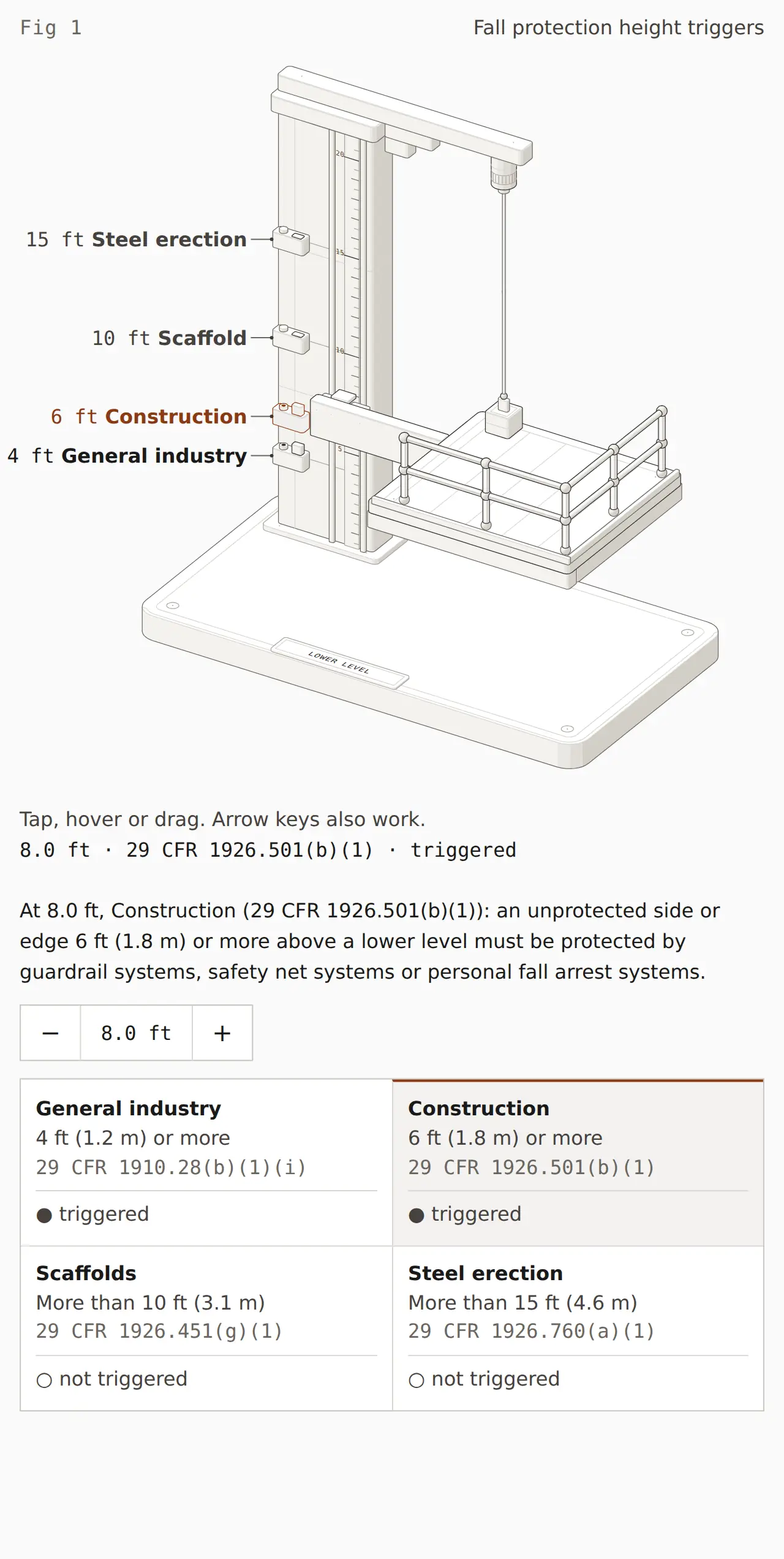
Duty to have fall protection
29 CFR 1926.501Scaffolding, general requirements
29 CFR 1926.451Ladders
29 CFR 1926.1053Fall protection training
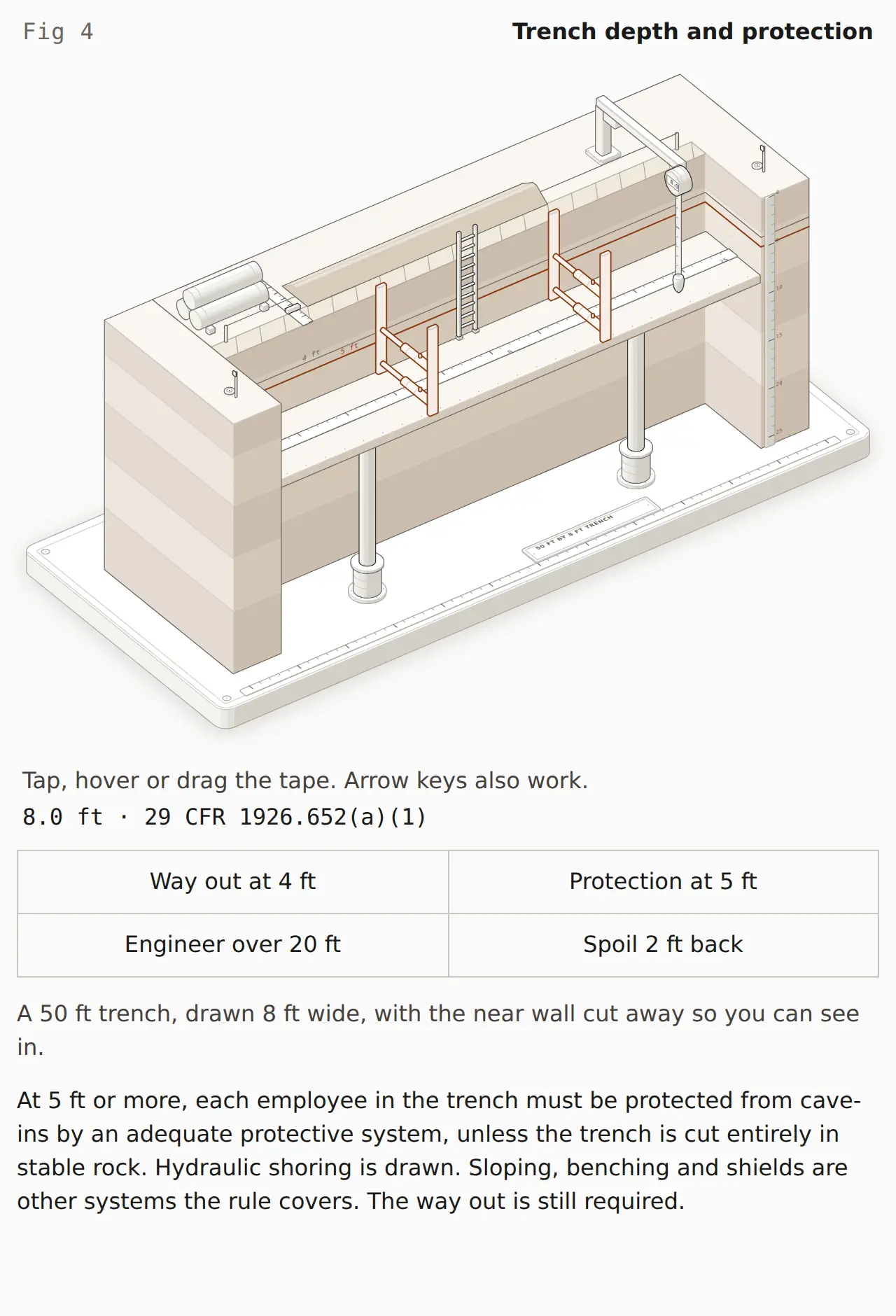
29 CFR 1926.503Excavations, requirements for protective systems
29 CFR 1926.652
The questions that won't go away
The list covers the compliance questions Construction teams bring us again and again, and Cairn answers each one with the standard, the citation, and a source you can open.
Fall protection plans need to be adequate for both residential and commercial work.
Trenching and excavation work needs documentation from a competent person.
Silica exposure assessments need to follow Table 1 of the silica standard.
Crane operators need certification and recertification.
Multi-employer worksites raise questions about which employer is responsible and how to defend a citation.
A question Cairn answers in seconds
"My framers are on a residential roof under 50 feet. Can we use a safety monitor instead of harnesses?"
- Industry
- Construction (NAICS 23)
- Cites
- Compliance Guidance for Residential Construction
- Ref
- Agency interpretation
Plays that pay back the subscription
Before mobilization
Check the project address against past inspections of the general contractor and the relevant subcontractors.
Toolbox talks
Produce a 5-minute talk based on the citations issued in your trade last week.
Contesting a citation
Find every earlier contest in which similar facts led to a citation being deleted or downgraded.
For more on Construction risk, see the OSHA citation-risk data for your NAICS code, compare your numbers with TRIR and DART benchmarking by industry, or search the full OSHA enforcement record for inspections and violations in your sector.
Construction OSHA compliance, answered
What are the OSHA fall protection requirements for construction?
Subpart M of 29 CFR 1926 requires fall protection for most construction work at six feet or more above a lower level (29 CFR 1926.501), plus training under 1926.503. Fall protection is the most-cited standard in construction, so Cairn shows the controlling 1926 text and the interpretation letters behind every answer.
Which 29 CFR 1926 standards does OSHA cite most in construction?
Fall protection (1926.501), scaffolding (1926.451), ladders (1926.1053), fall protection training (1926.503), and excavations (1926.652) lead construction citations. Use the free citation-risk tool to see the standards cited most for NAICS 23 in your state.
Does OSHA require a competent person for trenching and excavation?
Yes, 29 CFR 1926.651–652 (Subpart P) require a competent person to inspect excavations daily and select a protective system. Cairn returns the cited requirement and the related directives, so your documentation holds up.
Browse all OSHA compliance solutions by industry.