NAICS 325
OSHA compliance for chemical manufacturing: PSM, RMP, and hazcom.
OSHA compliance for chemical manufacturing carries the heaviest combined load from two agencies in the federal record, OSHA and the EPA. Cairn brings process safety management (PSM 1910.119), RMP, hazard communication, and lab safety together in one set of cited answers for NAICS 325 plants, with investigation reports of similar processes indexed alongside the standards they involve.

PSM elements
Each PSM element is linked to citation precedent and current interpretation guidance.
Process safety incident reports
Cairn shows indexed investigations of similar processes when they apply to your question.
Hazard communication under GHS
The hazard communication standards, including labeling for in-process intermediates.
Laboratory safety and PSM
Cairn shows where lab safety and process safety management overlap, and it keeps both current.
Interactive figure
Testing a tank's air before anyone goes in
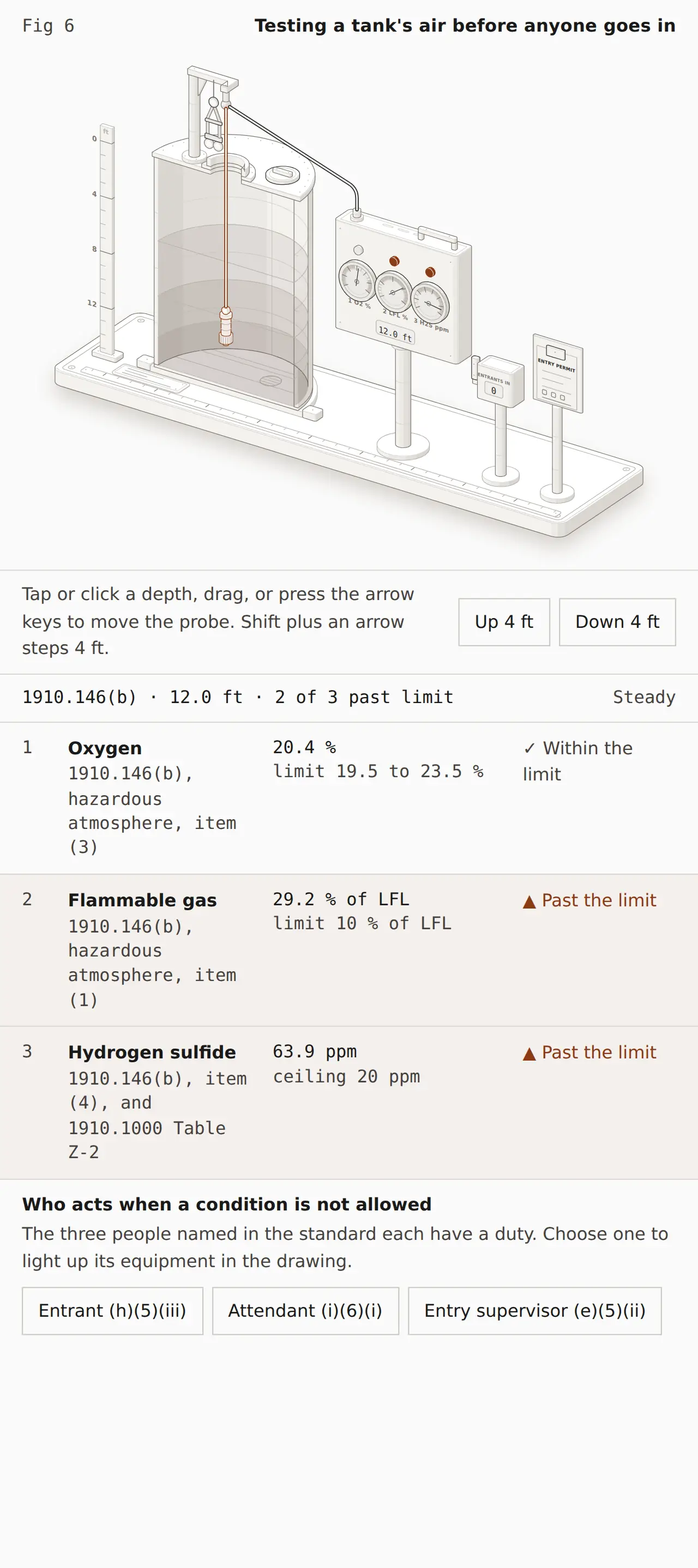
The standards your inspector opens first
The standards below are the most cited in Chemical Manufacturing (NAICS 325), and every reference links to the standard on osha.gov.
Process safety management
29 CFR 1910.119Hazard communication
29 CFR 1910.1200Personal protective equipment, general requirements
29 CFR 1910.132Permit-required confined spaces
29 CFR 1910.146Hazardous chemicals in laboratories
29 CFR 1910.1450
The questions that won't go away
The list covers the compliance questions Chemical Manufacturing teams bring us again and again, and Cairn answers each one with the standard, the citation, and a source you can open.
PSM mechanical integrity programs, and their inspection and testing procedures, need to be defensible.
Process hazard analysis (PHA) revalidations need a schedule, and findings need to be tracked.
In-process intermediates need hazard communication labels that follow the Globally Harmonized System (GHS).
Some lab safety programs overlap with PSM requirements.
Investigation reports need to be tracked.
A question Cairn answers in seconds
"For a reactive batch process, what depth of HAZOP does the agency expect under PSM (e)?"
- Industry
- Chemical Manufacturing (NAICS 325)
- Cites
- PSM Compliance Directive
- Ref
- Agency directive
Plays that pay back the subscription
Defending a PHA
Find recent PSM (e) citations to support your process hazard analysis (PHA) methodology.
Checking an incident
Compare your recent incident with published findings on similar processes.
Commissioning a new product
Prepare the process safety information (PSI) package and operating procedures based on your existing program.
For more on Chemical Manufacturing risk, see the OSHA citation-risk data for your NAICS code, compare your numbers with TRIR and DART benchmarking by industry, or search the full OSHA enforcement record for inspections and violations in your sector.
Chemical Manufacturing OSHA compliance, answered
What does PSM 1910.119 require for chemical manufacturers?
Process safety management under 29 CFR 1910.119 requires process safety information, process hazard analyses, mechanical integrity, management of change, and the other 10 elements for covered processes that hold threshold quantities. Cairn maps each PSM element to citation precedent and current interpretation guidance for NAICS 325 plants.
What's the difference between PSM and RMP for a chemical plant?
PSM (OSHA, 29 CFR 1910.119) protects workers inside the plant, and RMP (EPA, 40 CFR 68) protects the surrounding community. The two overlap heavily for chemical manufacturers. Cairn covers both in one set of cited answers, so you can handle the requirements of both agencies in a single query.
How does chemical OSHA compliance differ from oil and gas?
Chemical manufacturing is NAICS 325 and centers on PSM, RMP, and hazard communication at the plant. Our OSHA compliance for oil and gas page describes PSM, HAZWOPER, and well control from the upstream and midstream side.
Browse all OSHA compliance solutions by industry.